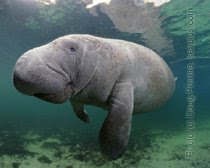
A recent headline in the Tampa Tribune reports that Florida manatee mortality has increased in recent years due to red tide and cold weather events. Manatee advocates interviewed in the article argue that these events should stall any movement to down-list manatees from endangered to threatened. Others, including property rights advocates and recreational boaters, argue that manatees should be upgraded from endangered to threatened. Yes, these two (often polarized) stakeholder groups actually use a different word to describe reclassification. What do you think?
Save the Manatee Club's Webcam captures manatees aggregated at Blue Springs...note the mother-calf pairs!
As a scientist, I believe it is important to consider all the available data before voicing an opinion to decision makers. No matter what your perspective, it is imperative that you have the facts (data) before lobbying for your case with lawmakers. In most cases, the legislators have little or no understanding of biology, ecology, conservation, or behavior. So, it's important to be able to develop of logical argument for your perspective, supported by data and established biological concepts. Here are some resources that may help you develop your argument:
Background and Legal Status
West Indian manatees were listed as endangered by the US Fish & Wildlife Service (FWS) in 1967. When the Marine Mammal Protection Act (MMPA) was passed in 1972, West Indian manatees gained federal protection. The following year (1973) the new US Endangered Species Act (ESA, which celebrates its 40th Anniversary this year) listed manatees as endangered.
At the state level, manatees were added to Florida's imperiled species list as threatened in 1974. In 1979, the status was changed to endangered (2007 Florida Manatee Management Plan). During these early years, manatee status was based on qualitative, rather than quantitative data. In fact, very little data were available at that time.
In 1999, the Florida Fish and Wildlife Conservation Commission (FWC) adopted new rules to standardize how species are evaluated for inclusion on the state's imperiled species list. In 2001, the FWC received a petition to reclassify the manatee. Final action on that petition was delayed until April 2005, when a biological review committee recommended upgrading manatees from endangered to threatened. The FWC Commissioners accepted this recommendation in 2007. However, before official action was taken, the 2007 IUCN Red List assessment was published, categorizing the Florida manatee as endangered (C1 ver 3.1). Additionally, Florida Governor Charlie Crist sent a letter to the FWC, asking Commissioners to postpone a decision until the state could come up with a better method to estimate manatee population numbers.
In 2010, new threatened species rules approved by the Florida FWC Commission went into effect. The 2013 revised list of Florida's Threatened and Endangered Species reflected the changes to the rules. Basically, all federally listed species that occur in Florida were included on Florida’s list as Federally-designated Endangered or Federally-designated Threatened species. Since manatees are Federally-designated Endangered, they remain listed as endangered in Florida.
This moves the battle between manatee and property-rights/recreational boater advocates in Florida to the federal level. In December 2012, the Pacific Legal Foundation, representing Save Crystal River, a property rights organization, filed a petition with the USFWS to down-list manatees. According to the petition, FWS has 90 days to respond. As of this writing, nothing official has been published regarding the petition. Save the Manatee Club and other manatee advocates continue to argue that the status should remain endangered.
Several types of aerial surveys are used to count manatees in Florida. The numbers mentioned in the Tribune article (1000 in 1973; 5000 in 2013) reflect the number of manatees counted during synoptic aerial surveys. These counts are NOT statistically valid population estimates.
Synoptic surveys are simultaneous aerial surveys conducted each winter, which cover known manatee habitat where manatees aggregate on warm water effluents during cold spells. The Florida Fish and Wildlife Conservation Commission (FWC) uses these surveys to obtain a minimum count of manatees statewide. Synoptic surveys are flown by an interagency team, usually one to three times each year, during the coldest days. The survey meets Florida's statute 370.12 (4), which requires an annual, impartial, scientific benchmark census of the manatee population. From 1991 through 2011, the counts have been conducted 27 times and these data are available online. However, variables other than actual population size significantly affect the probability of counting a manatee, given a manatee is present in Florida's waters. Therefore scientists have been reluctant to give actual population estimates, or even trends from year to year.
Rescue and Mortality Response
Florida Fish & Wildlife Conservation Commission (FWC) staff located throughout Florida are responsible for investigating every report of a dead or injured manatee. FWC researchers work closely with law enforcement, volunteers, agencies, and organizations to verify injured or dead manatees. Once confirmed, a rescue or carcass salvage is initiated. Injured manatees are transported to manatee rehabilitation facilities; manatee carcasses are transported to the St. Petersburg pathology lab, where a necropsy is performed to determine cause of death and collect other life history and pathology data. Mortality data are posted at on FWC's website. Scientist have a lot more confidence in manatee mortality estimates than they do in manatee population estimates.
Correlation between Counts and Deaths?
By plotting trend lines for manatee synoptic survey counts and manatee mortality by year, we see that the two are positively correlated in some years and negatively correlated in other years. Notice where the two lines touch (2002). The minimum count for 2002 (1,758) was significantly lower than the year before (3,300) and the year after (3,127). Scientists are confident (based on what we know about manatee biology, reproduction, and life history) that the population could not have possibly declined 50% one year and then increased 100% the next year. More likely, the low synoptic survey count was due to a mild winter and poor visibility, making it difficult for observers to see manatees during the flights (Journey North). The high mortality was due to a significant red tide event.

So, if we cannot estimate manatee population numbers with statistical confidence, how did the IUCN assess the population as endangered in 2007 Here's the explanation:
Trichechus manatus latirostris (EN C1):
The Florida manatee subspecies is listed as Endangered on the basis of a population size of less than 2,500 mature individuals and the population is estimated to decline by at least 20% over the next two generations (estimated at ~40 years) due to anticipated future changes in warm-water habitat and threats from increasing watercraft traffic over the next several decades. In an attempt at full disclosure, you should know that I worked on the IUCN Assessment for the Antillean subspecies that year and am a co-author on this assessment. Multiple lines of evidence, including modeling, probability of sighting data, proportion of calves/juveniles to adults data, and other life history data to make estimates. However, some scientists call them guesstimates rather the estimates because they are derived, in part, from data that cannot be statistically analyzed.
What do I think? Should the Florida manatee be down-listed? Using the Precautionary Principle, I am not aware of statistically valid data that would support downlisting. However, if the legal status for manatees is changed from endangered to threatened, the species is still at risk of extinction. Existing protection must remain in full force. To reduce protection would likely produce a significant and deleterious effect on the manatee population in Florida.
Read the Tribune Story here: http://tbo.com/news/florida/manatee-deaths-spike-due-to-red-tide-freezes-20130708/